Daniel Whitmore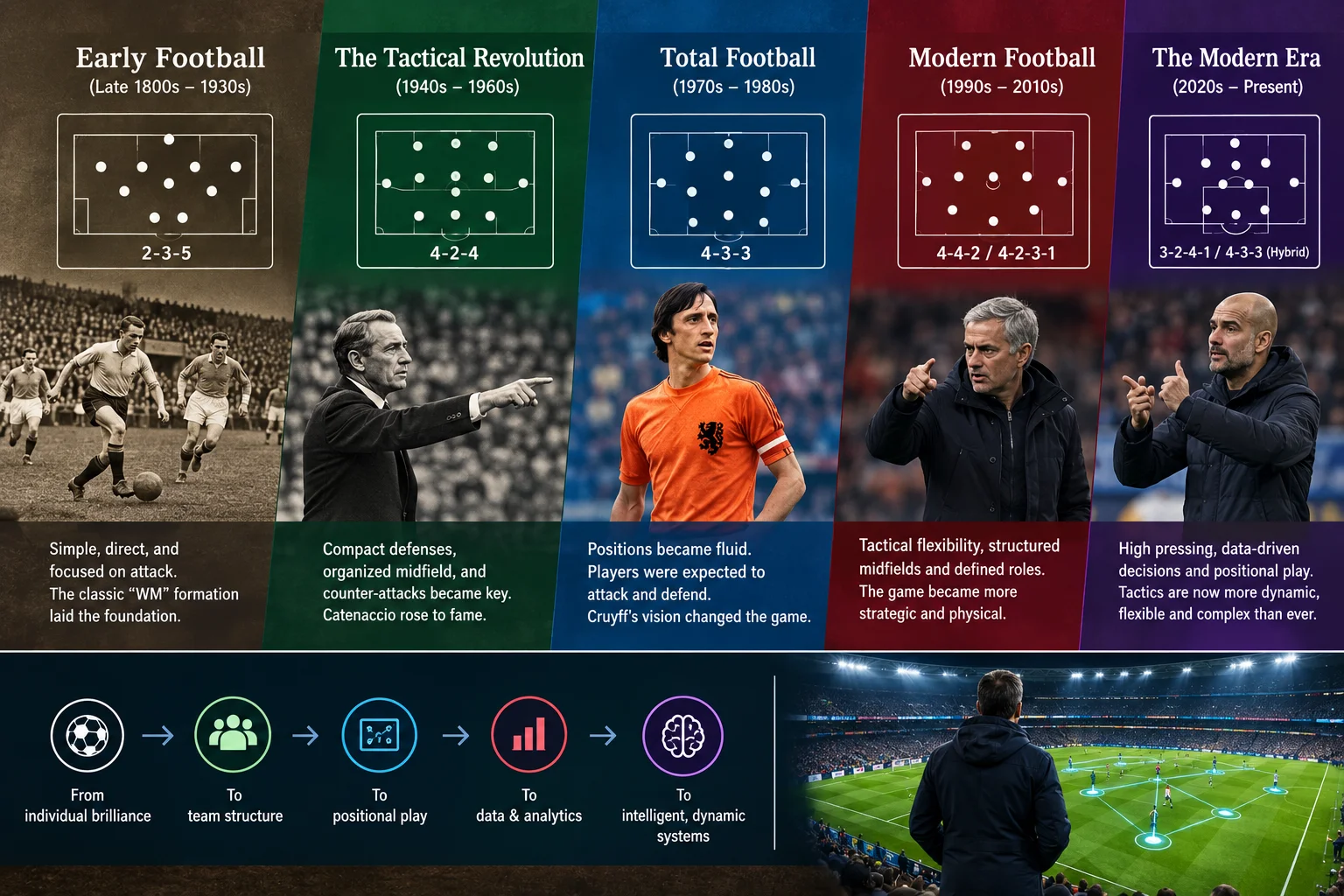
The football played today would be unrecognisable to the first professionals, not because the players are better, though they are, but because the entire idea of how to organise a team has changed many times over. Tactics evolve in response to each other: a new way of attacking produces a new way of defending, which produces a new way of attacking again. Following that cycle is one of the most interesting ways to understand the game.
How did early football look?
Chaotic, and heavily weighted towards attack.
The earliest organised football had almost no defensive organisation. Teams played with many forwards and few defenders, the ball was dribbled rather than passed, and the games were high-scoring free-for-alls. The idea that a team might deliberately not attack, or might organise itself to stop the opposition, had barely occurred to anyone. Football was about going forward.
The first great tactical insight, developed early in Scotland, was passing: moving the ball between players rather than each man dribbling until he lost it. That alone transformed the game and set everything else in motion.
What was the first defensive revolution?
The shift towards organised defending as attacking play improved.
As passing made attacks more effective, teams had to find ways to stop them, and defensive organisation was born. Formations began to balance attackers and defenders more evenly, and the role of defending became a deliberate craft rather than an afterthought. Over the following decades, formations shifted steadily to put more players in defensive and midfield roles, reflecting a growing understanding that control of the middle of the pitch mattered.
Each formation was a response to the problems the previous one had created, and the general direction was towards more structure and more balance.
How did total football change things?
By breaking the idea that players had fixed positions.
One of the most influential tactical developments was the idea that players could interchange positions fluidly, with a defender moving into attack and a teammate covering the space behind him, the whole team shifting as a unit. This demanded players comfortable in several roles and extremely fit, and it produced football of a fluidity that had not been seen before. Its influence runs through much of the modern game.
It also raised the technical and physical demands on players enormously, since a system where anyone might have to play anywhere requires everyone to be good at everything.
What drove the possession era?
The belief that keeping the ball was both attack and defence.
A later major development was the idea that dominating possession, through short passing and constant movement, could control a match completely: the opposition cannot score without the ball, and a team that keeps it also tires the opponent and dictates the tempo. Taken to its extreme, this produced sides that kept the ball for long periods, probing for openings, and it dominated the game for a period.
It also produced the response that defines much of today’s football, because a team committed to possession is vulnerable at the moment it loses the ball.
Why do formations keep changing?
Because a formation is a set of trade-offs, and the right trade-off depends on the opponent.
Every formation strengthens some areas of the pitch at the cost of others. More midfielders means more control but fewer attackers; a higher line means more pressure but more space behind. As the dominant way of playing shifts, the formations that counter it come into fashion, and managers increasingly change formation from match to match, or within a match, to suit the opponent rather than committing to one shape for a season. The days of a club playing the same formation every week for years have largely gone.
How did pressing become dominant?
As the answer to possession football.
If a possession team is most vulnerable the instant it loses the ball, the way to beat it is to win the ball back immediately and attack before it can reorganise. Pressing, closing down the player in possession high up the pitch to force mistakes, became the dominant idea precisely because it attacked the weakness of the possession game. Our piece on why Premier League midfielders matter covers the players who make it work.
Modern football combines the two: teams press to win the ball and then keep it, pressing and possession no longer opposites but parts of the same approach.
Do all teams play the same way?
No, and the variety is part of what makes the game interesting.
At any given moment, the dominant tactical idea is adopted by many teams but not all. Some clubs commit fully to the fashionable approach; others build their identity on resisting it, defending deep against possession sides or sitting off the press. A league where every team played identically would be dull, and the clubs that succeed by doing the opposite of the fashion are often the most interesting to watch.
A manager’s choice of approach also depends on the players available. A squad built for pressing cannot suddenly become a possession side, and the best managers play to what their players do well rather than imposing a system that does not fit. Tactics are shaped by personnel as much as by fashion.
What comes next?
Whatever answers the current dominant idea.
Tactics move in cycles, and every approach that dominates eventually produces its own counter. Some teams already sit deep and invite the press, then attack the space behind it. Others vary their approach within a match to stay unpredictable. The one certainty is that the current way of playing is not the final one, because football tactics have never stopped evolving and show no sign of starting now.
Understanding that cycle, action and reaction, attack and counter, is the key to watching the game with real understanding. What looks like a settled way of playing is only the current move in a conversation that has been going for over a century.
The best way to watch with this in mind is to ask, of any team, what problem its approach is trying to solve and what weakness it accepts in return. Every tactical choice is a trade, and seeing the trade is seeing the game as the coaches do.
Frequently asked questions
How have football tactics changed over time?
From early attacking free-for-alls with little defensive organisation, through the development of passing, defensive structure, fluid position-switching, possession football and pressing, each a response to what came before.
What is total football?
A tactical approach in which players interchange positions fluidly, with teammates covering the space left behind, requiring players comfortable in several roles and extremely fit.
Why do football tactics keep changing?
Because each approach produces a counter. A new way of attacking creates a new way of defending, which creates a new way of attacking, in a cycle that has continued throughout the game’s history.