Daniel Whitmore
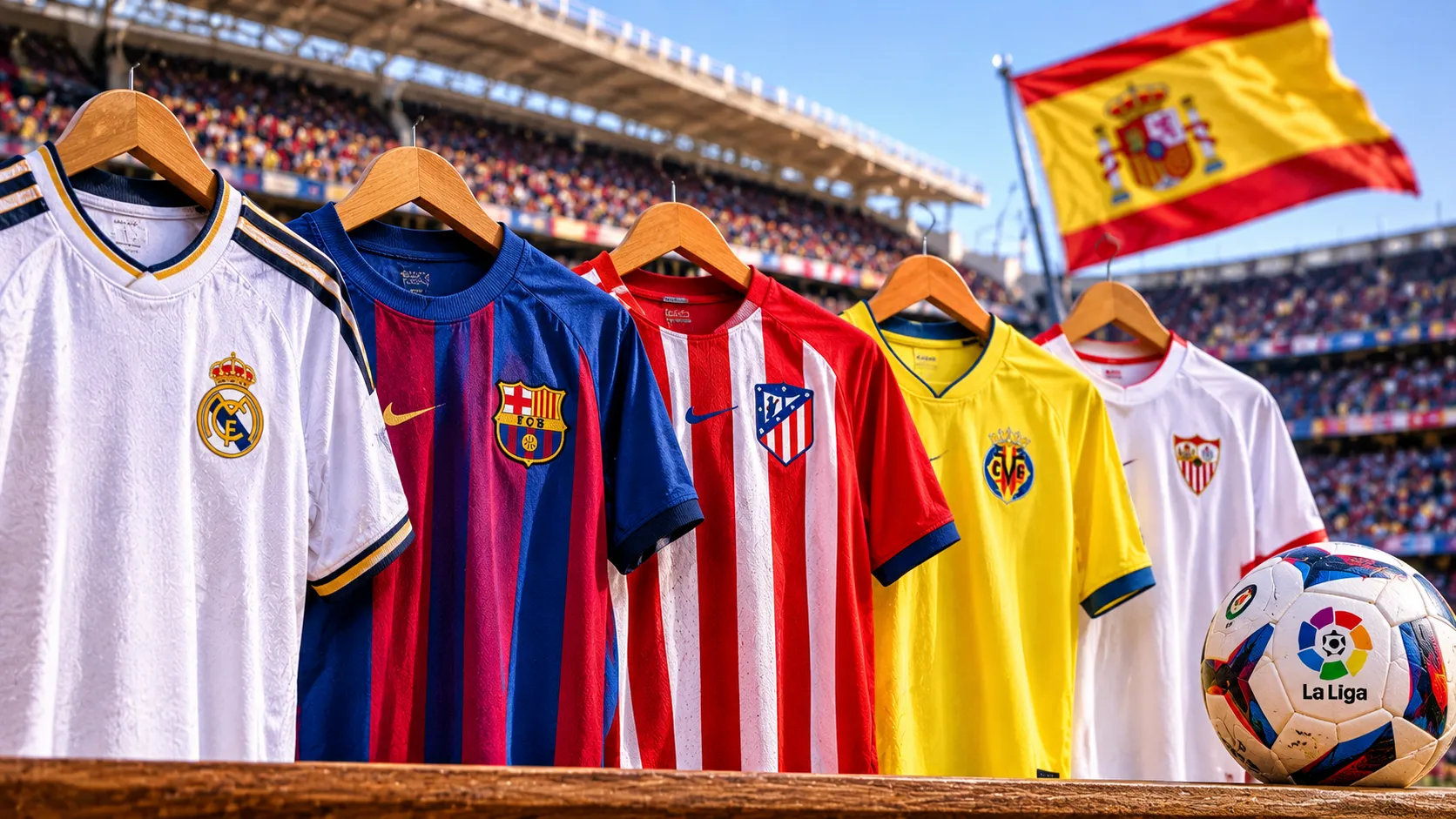
Buying la liga shirts from England is more straightforward than it used to be and more complicated than buying a Premier League one. The designs are frequently better, the back catalogue is extraordinary, and the two things that catch English buyers out are sizing and delivery both of which are solvable once you know about them.
This is a guide to the league’s shirts from an English buyer’s point of view: which clubs have the distinctive identities worth knowing, how the sizing differs, and what to check before you order.
Which clubs’ shirts define the league?
Real Madrid in all white, a choice that has been copied so often it is now shorthand for a certain kind of ambition Leeds United adopted it deliberately in the sixties for exactly that reason.
Barcelona in blaugrana, the deep blue and claret stripes, which are the subject of a long-running argument about whether they are stripes or halves depending on the season’s design. Barcelona also carried no shirt sponsor at all until the mid-2000s, when they began wearing UNICEF and paid for the privilege rather than being paid a genuinely unusual arrangement and one supporters still reference.
Atlético Madrid and Athletic Bilbao in red and white stripes, which look similar at a glance and are not: Atlético pair theirs with blue shorts, Bilbao with black. Real Betis in green and white stripes, Villarreal in yellow, Valencia in white. It is a league of strong, simple identities, which is part of why the shirts travel so well.
Why does Spanish sizing run small?
Because it is cut on continental European blocks rather than UK ones, and the difference is consistent enough to plan around. An English buyer taking a large in a Premier League replica will frequently want an extra large in a Spanish-made shirt of the same nominal tier.
The gap widens on the authentic or player versions, which are cut for professional athletes on top of the regional difference. A player-issue Spanish shirt can run close to two sizes smaller than the equivalent English replica, which is the single most common cause of a return.
The fix is the one that always works: measure a shirt you already own flat across the chest, armpit to armpit, and compare that figure against the seller’s published measurements. Ignore the letter on the label entirely, as our Premier League shirts season guide also recommends for the domestic ranges.
Delivery, duty and the thing to check first
Where the seller ships from matters more than where the club plays. A Spanish club’s shirt bought from a UK-based retailer arrives like any domestic order. The same shirt bought directly from Spain is an import, and that changes the arithmetic.
Imports can attract duty and a handling fee, and the charge frequently exceeds whatever saving prompted the order in the first place. It also lands after you have paid, which is how a bargain becomes an annoyance. Check the seller’s despatch location before comparing prices, not after.
Delivery times are the other variable. A direct order from Spain is typically a week or more, longer if customs look at it, and returns run the same route in reverse at your expense unless the seller covers it. For anything you might need to send back, a UK-based stockist is worth a few pounds more.
The back catalogue, which is the real draw
Spanish football’s shirts from the nineties and 2000s are among the most collected in the world, and for good reason the designs were bolder than the English equivalents and the sides wearing them were frequently the best in Europe.
The practical note for a buyer is that the licensing is patchier than in England. Several of the original suppliers no longer hold the rights, which means the official reproduction market covers only part of what people want, and the gap is filled by unlicensed tribute shirts with no crest.
Those tributes are legal and often very well made. What is not legal is a tribute with a badge added, and that is a line worth knowing before you buy anything described as a remake of a specific season.
Printing and patches, which differ from England
Worth knowing before you order, because the conventions are not the same. La Liga uses its own official typeface for names and numbers, distinct from the Premier League’s, and a Spanish shirt printed in an English font is wrong in a way that is obvious to anyone who follows the league.
The competition patch arrangement differs too. Spanish league shirts carry a league badge on the sleeve, and clubs in European competition wear different patches for those fixtures so a shirt’s sleeve tells you which competition it was configured for, not just which season.
If you want printing, have it done by a seller who stocks the correct La Liga lettering rather than a general print shop. It costs a little more and it is the difference between a shirt that looks right and one that looks like a souvenir.
Where to start if you are buying one
Pick the club rather than the design. These are shirts with strong identities attached, and a Betis shirt bought because you liked the green is a different thing from one bought because you have been to the Benito Villamarín.
If you want something that will still look right in a decade, the plain ones age best Real Madrid’s white, Valencia’s white, Villarreal’s yellow. If you want something with more going on, the striped sides give you a design that is instantly identifiable from across a room.
And consider last season’s. Spanish clubs run the same release cycle as English ones home shirt before the season, away soon after, third a month or two in so last year’s alternatives are heavily discounted by spring and look no different to anyone who is not checking the sponsor.
The second-tier clubs worth knowing
The league below the giants is where the interesting shirts are, and English buyers rarely look there. Real Sociedad in blue and white stripes, Celta Vigo in sky blue, Osasuna in red, Rayo Vallecano with the diagonal red sash that is one of the most distinctive designs in European football.
Rayo’s sash has a story attached, which is part of why it sells: the club is rooted in a working-class district of Madrid with a politically engaged support, and the shirt functions as a statement rather than merely a kit. Shirts with that kind of weight behind them hold their appeal far longer than a design that was simply fashionable.
For an English buyer these are also the cheapest shirts in the league, because demand outside Spain is modest. A Rayo or Celta shirt costs a fraction of a Real Madrid one and is considerably less likely to be seen on anyone else at five-a-side.
What English buyers get wrong
Three things. Ordering on the size letter, which is the main one and produces most returns. Assuming the shirt ships from the UK, which produces the duty surprise. And buying a player version because it sounded better, then finding it does not fit and cannot be returned once printed.
None of those is complicated to avoid. Measure, check the despatch country, and buy the standard replica unless you intend to play in it. The league’s structure and how its clubs compete is a separate subject, and how the Champions League league phase works covers where Spanish sides meet English ones.
Frequently asked questions
Do Spanish football shirts run smaller than English ones?
Yes, consistently. They are cut on continental European blocks, and an English buyer will often need one size larger than in a Premier League replica more again for a player version.
Will I pay duty on a shirt from Spain?
Potentially, plus a handling fee, if the seller despatches from outside the UK. Check the despatch location before comparing prices, because the charge can exceed the saving.
Why did Barcelona have no shirt sponsor for so long?
The club declined commercial sponsorship until the mid-2000s, then wore UNICEF and paid for the arrangement rather than receiving a fee. Paid sponsorship came later.
Are unlicensed Spanish retro shirts legal?
Yes, provided they carry no crest, sponsor or supplier branding. Adding a club badge to one makes it counterfeit regardless of how it is described.