Daniel Whitmore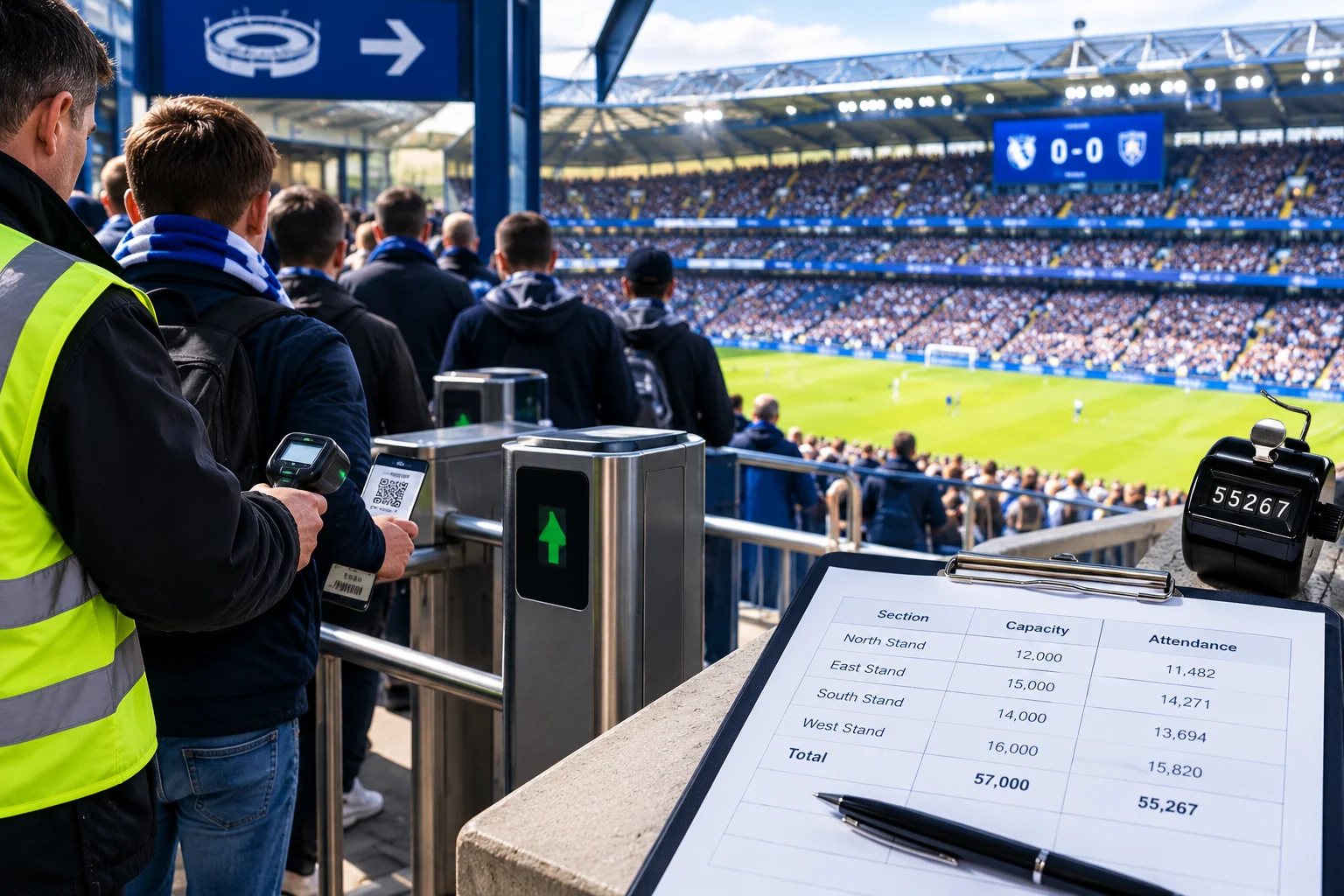
A figure gets announced over the public address system, printed in the programme and reported in the following day’s coverage, and almost everyone takes it to mean the number of people in the stadium. For most matches in English football, it does not.
The gap between the announced attendance and the number of bodies present is usually a few thousand, occasionally more, and it is entirely legitimate it is a consequence of what the figure is defined to measure. Once you know the definition, visibly empty seats in a “sold out” ground stop being a contradiction.
Tickets issued, not people present
In the Premier League and in most of the professional game, the reported attendance is the number of tickets issued for the match. That includes every season ticket for the stadium, whether the holder attended or not, plus match tickets sold, plus complimentary and corporate allocations.
Season tickets are the main source of the difference. A club with forty thousand season-ticket holders counts all forty thousand every week, and on a wet Tuesday in February a meaningful proportion of them will not be there. The seat is paid for, the ticket was issued, and the figure reflects that.
This is not a trick. It is a consistent, auditable measure that does not depend on turnstile hardware working properly, and it is the number clubs use for their own revenue reporting. It simply is not the same thing as a headcount.
Why not just count the turnstiles?
Clubs do count them, for safety and operational reasons, and those numbers exist. They are generally not what gets published.
There are practical reasons. Turnstile counts need reconciling across dozens of entry points, they are affected by stewards admitting people through gates rather than turnstiles, and they are not available at the moment the announcement is made. There is also a commercial reason: a lower number is a worse story, and clubs have no incentive to publish it when the alternative measure is both defensible and consistent.
Historically, the turnstile count was the figure, which is why attendances recorded before the all-seater era are closer to a true headcount. The shift to ticket-based reporting came with season tickets becoming the dominant form of admission.
How the lower divisions and cup competitions differ
Reporting practice is not uniform across English football. The professional leagues broadly follow the tickets-issued approach, but individual clubs in the EFL and below vary, and some smaller clubs publish a figure much closer to an actual headcount simply because season tickets make up a smaller share of their gate.
Cup competitions add another wrinkle. Where a tie is played at a neutral venue, or where a club has reduced its allocation, the figure reflects what was issued for that specific configuration rather than the ground’s usual pattern. Early-round cup attendances are also affected by clubs offering heavily discounted or free admission to season-ticket holders, which boosts the issued number without necessarily filling the seats.
Non-league football is different again, and often more honest about it. At that level the figure announced is usually a genuine count taken on the day, which is why a reported crowd of four hundred and twelve looks so precise next to a Premier League figure ending in three zeros.
What does a stadium’s capacity actually mean?
A ground’s capacity is set by its safety certificate, issued by the local authority and informed by national safety guidance. It accounts for exit routes, stewarding levels, the condition of the structure and the characteristics of each individual section.
Capacity is therefore not a fixed property of the building. It can be reduced for a specific match — for a segregation arrangement, for building work, or where a section is closed — and it can be reduced permanently if conditions change. This is why a stadium’s stated capacity and the largest crowd it has actually held sometimes differ by thousands.
Away allocations sit inside this. Clubs in the Premier League are required to make a minimum proportion of capacity available to visiting supporters, and the figure is calculated from the certificated capacity rather than from the number of seats. Pricing for those tickets is capped, which we cover in a separate piece on away ticket price caps.
International matches follow their own conventions, and the figure given for a game at a national stadium is usually tickets distributed, including the substantial allocations given to county associations, clubs and commercial partners. Those allocations are returned at a higher rate than ordinary sales, which is why an international can be reported as a near sell-out and still have visible gaps.
Reading an attendance figure properly
Three practical adjustments. First, assume the figure is tickets issued and that the actual crowd is somewhere between ninety and one hundred per cent of it, depending on the weather, the opposition and the kick-off time.
Second, check what proportion of capacity it represents rather than looking at the raw number. Twenty-two thousand at a ground that holds twenty-four is a better crowd than forty-five thousand at a ground that holds sixty.
Third, be careful comparing eras. A crowd of sixty thousand on a terrace in the nineteen-seventies was a turnstile count in a standing ground, and comparing it with a ticket-issued figure for an all-seater stadium today is comparing two different measurements of two different things.
One further use of the figures is historical comparison within a single club. Because a club’s own reporting practice tends to be consistent over time, year-on-year changes in its announced attendances are meaningful even if the absolute number is not a headcount. A club whose issued figure falls by three thousand across two seasons has lost season-ticket holders, and that is a real signal regardless of how many people were in the ground on any given afternoon.
Why it matters beyond trivia
Attendance figures feed into a lot of decisions. They influence broadcast scheduling, commercial valuations, ticket pricing strategy and, at smaller clubs, the basic viability of the business. They also shape the public argument about whether football is pricing supporters out, and a measure that counts unused season tickets will always understate that problem.
Several supporter organisations have argued for turnstile counts to be published alongside the issued figure, on the reasonable basis that both are useful and only one is currently available. A handful of clubs do publish both. Most do not, and the reason is not complicated. The matchday experience itself is changing in other ways too, as the global appeal of the Premier League sets out.
Frequently asked questions
Is the announced attendance the number of people in the ground?
Usually not. In most of English professional football it is the number of tickets issued, including season tickets whose holders did not attend.
Why are there empty seats in a sold-out stadium?
Because every season ticket counts towards the figure whether it is used or not. A sold-out match can still have several thousand unoccupied seats.
Who sets a stadium’s capacity?
The local authority, through a safety certificate informed by national safety guidance. It can be varied for individual matches and is not a fixed property of the building.
Can old and new attendance records be compared?
Not directly. Older figures were turnstile counts in standing grounds; modern ones are tickets issued in all-seater stadiums. They measure different things. Transfers are similarly more complicated than they appear, as how a football transfer actually gets done explains.