Daniel Whitmore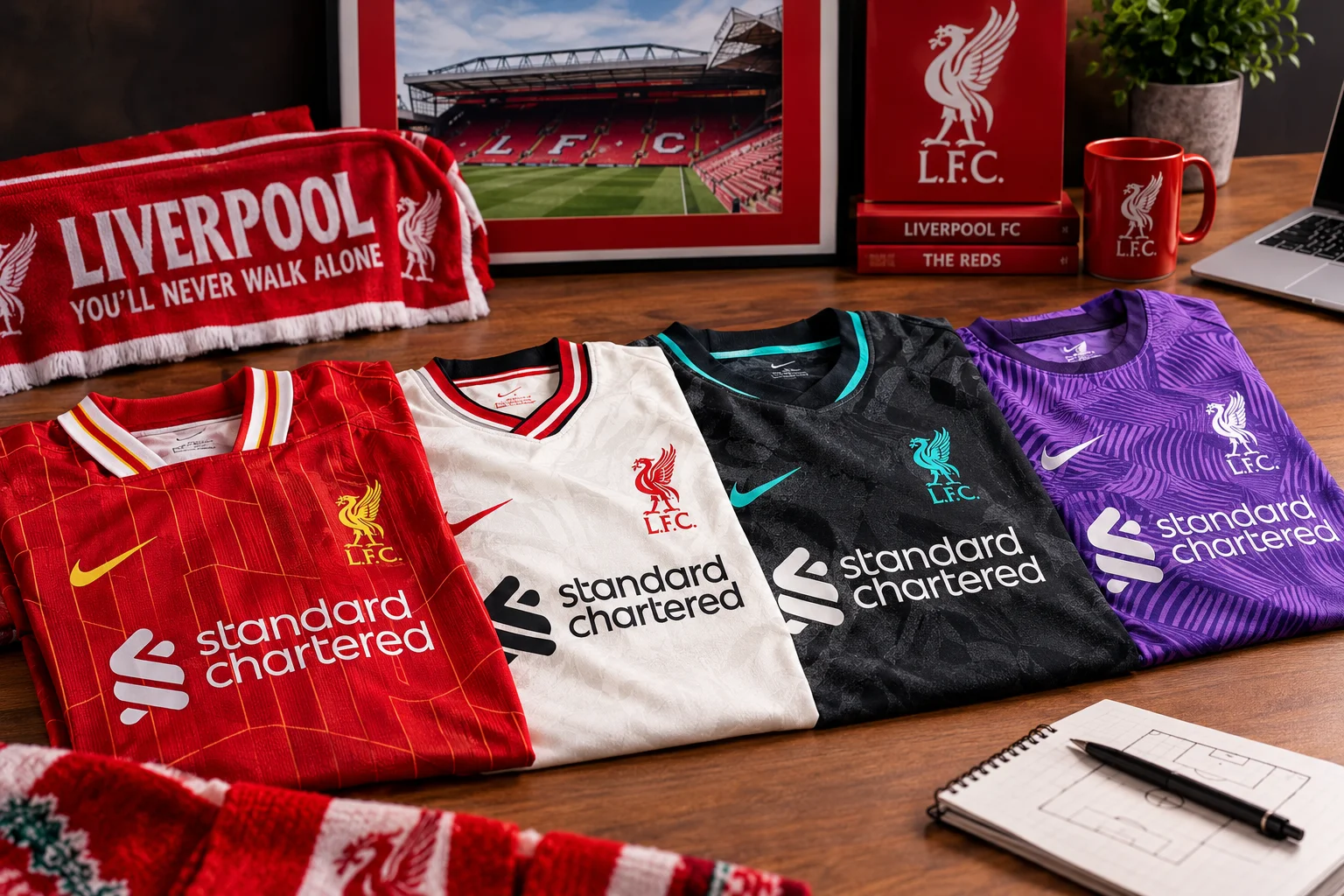
Liverpool’s home shirt is one of the few in world football that is recognised from the colour alone. All red, with a liver bird on the chest, and no significant variation from that for sixty years. It is simple, it is consistent, and it means a shirt from almost any recent season still looks current.
That consistency is helpful for a buyer and slightly misleading. Because the design barely changes, the differences between products are in the construction, the fit and the detail rather than in the look, and those differences are not obvious from a photograph. This guide covers what each part of the range actually is, what the various tiers give you, and how to buy well whether you are spending twenty pounds or a hundred.
Why is the home shirt all red?
Liverpool did not always play in all red. For decades the club wore red shirts with white shorts, and the switch to a single colour came in the mid-nineteen-sixties under Bill Shankly, who believed an all-red side would look more imposing. It worked well enough that the club never went back.
What has changed since is the detail. The liver bird has been through several treatments, the collar has moved between a crew, a polo and a V-neck depending on the era, and the trim has gone through white, yellow and gold phases. Those details are how you date a red shirt, and they are worth checking if you are buying for a specific season rather than for the current one.
The sponsor is the other marker. Liverpool were the first English top-flight club to carry a shirt sponsor, towards the end of the nineteen-seventies, and the names that have followed are a reliable guide to the decade. If a listing’s photograph and its season description disagree on the sponsor, the listing is wrong.
The three product tiers
Modern liverpool football shirts are sold in two or three versions of the same design, and the names change with the supplier.
The standard replica is the entry product. It is cut generously, made from a single fabric throughout, and has a stitched or heat-applied badge. It is the most comfortable of the three for ordinary wear and the most durable in a washing machine.
The mid-tier, where it exists, adds a better fabric and sometimes ventilated panels. The top tier — usually called the authentic or player version — is what the squad wears: cut close, lighter, with bonded seams rather than stitched ones and engineered ventilation in specific areas.
The price difference between bottom and top is often close to double. The honest guidance is that the player version is a better garment if you are going to run in it and a worse one if you are not, and that it runs at least a size small because it is cut for a professional athlete’s body.
Away and third shirts
With the home shirt fixed, Liverpool’s alternatives are where the design work happens, and over the years they have covered white, yellow, grey, black, ecru and several shades of green and teal. Some are well loved and some are remembered mainly as experiments.
For a buyer, this is where the value in the range sits. Alternative kits are produced in smaller quantities and discounted earlier and harder than home shirts, so a season-old away shirt often costs less than half what the home shirt does. If you want something from a particular year without paying current-season prices, start here.
The one thing to check is which season a listing actually refers to. Away shirts sometimes launched mid-season and occasionally carried a different sponsor arrangement, so match the sponsor and the supplier to the year before ordering. Our wider guide to buying football shirts online in the UK sets out the checks that apply to any club.
Retro, training and kids
The retro range is substantial, because the club’s history gives reproducers plenty to work with. Retro shirts are cut boxier through the body and shorter in the sleeve than modern kit, so measure a shirt you already own flat across the chest rather than trusting the size letter. Check whether the version you are buying is officially licensed or a generic tribute, because the badge treatment is usually where that shows.
Training wear is the most overlooked part of any club range and often the best value. Training tops use the same technical fabrics as match kit, are cut for movement, and cost less because they carry no competition patches or sponsor arrangement. If you want something to exercise in, this is where to look.
Children’s kit follows the adult range but is sold by age rather than measurement, and age labels vary significantly between suppliers. Buy on the chest measurement where it is given, and size up rather than down — a slightly loose shirt lasts two seasons. Our England kids’ kit sizing guide goes into how the labelling works.
Printing, patches and what is included
A retail shirt does not come with the details a match shirt has, and this surprises people. Competition sleeve patches are licensed separately and are normally sold as an optional extra, applied at the point of purchase rather than included. Official name and number printing is also an add-on, produced to a league specification by a licensed supplier.
Two things follow. The first is that the quoted shirt price is rarely the final price once you add a name, a number and the patches. The second is that printing applied anywhere other than an official outlet will use the wrong font and a thicker transfer, and it will crack within a season. If you want printing, have it done at the point of sale.
It is also worth deciding before you order. Retailers will not usually print a shirt that has already been sent out, and a printed shirt is generally non-returnable, which is a real consideration if you are unsure about sizing.
Which version should you buy?
For a supporter who wants the current shirt to wear to matches, the standard replica is the right product, and buying a month or two into the season rather than at launch usually saves something without any downside.
For someone who plays or trains, buy training wear or a player version. For a gift, last season’s away or third shirt is the best value in the whole range. And for a collector, the retro reproductions are where the interesting decisions are, provided you check the badge and the collar against a photograph first.
Frequently asked questions
Why do Liverpool play in all red?
The club wore red shirts with white shorts for decades before switching to a single colour in the mid-nineteen-sixties, a change introduced by Bill Shankly on the basis that an all-red team would look more intimidating.
Is the player version worth the extra cost?
Only if you intend to play in it. It is lighter, closer cut and has bonded seams, but it is less comfortable for casual wear and is sized for an athlete, so order a size up.
When are Liverpool shirts cheapest?
Away and third shirts start to be discounted around the turn of the year, and everything drops sharply once the following season’s kit is announced in the spring.
How do I date an older red Liverpool shirt?
Use the sponsor first, then the supplier’s logo, then the crest treatment and the collar shape. Those four together will usually place a shirt within a season or two. For something completely different, see how added time is calculated.