Daniel Whitmore
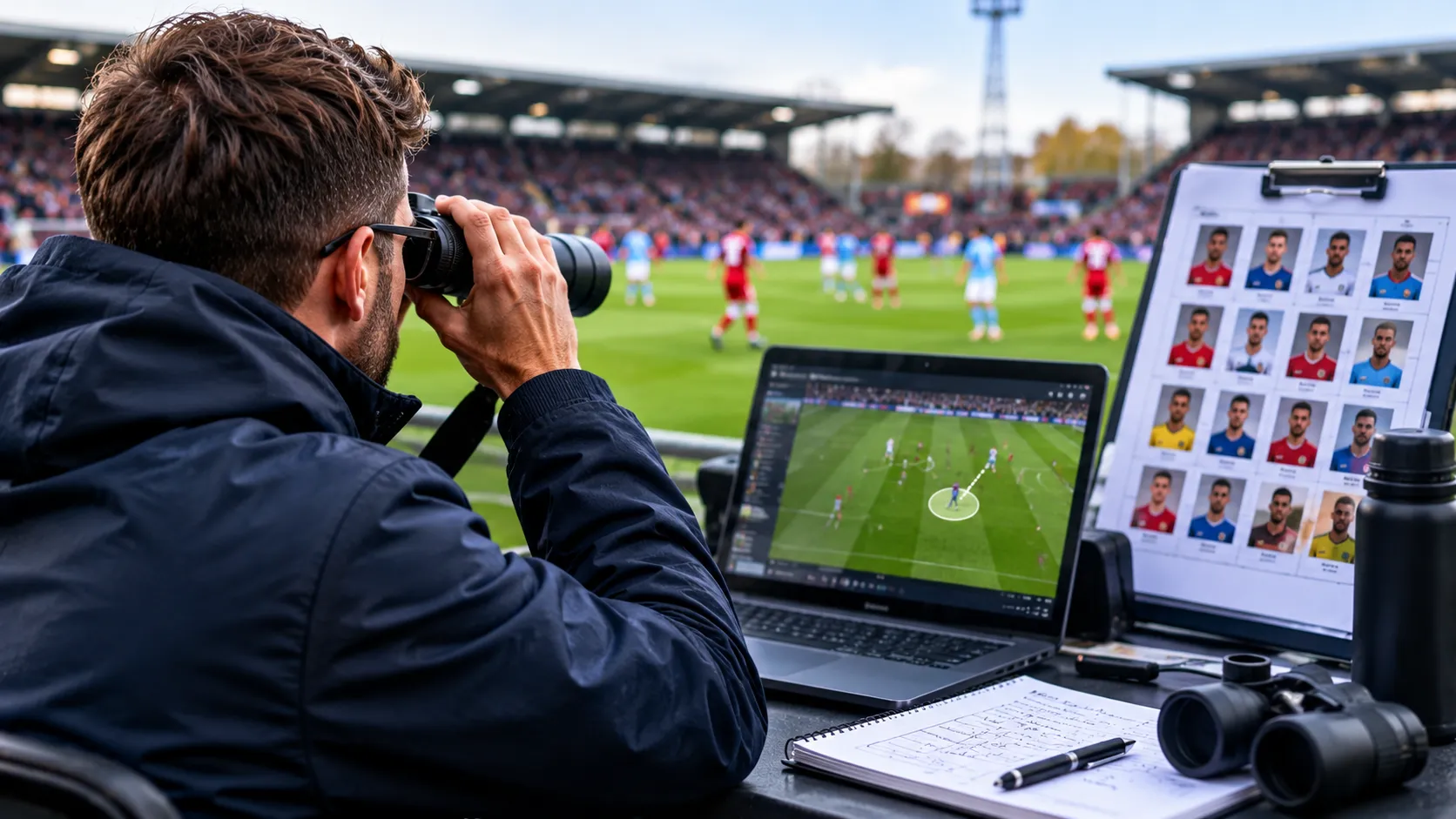
Ask what a football scout actually does and most people picture a man in an anorak behind a goal at a non-league ground with a notebook. That version exists and is a small part of a much larger operation, most of which now happens in an office with several screens.
The job has changed more in the last fifteen years than in the previous fifty, and the way it works now explains a good deal about why clubs sign the players they do.
There is more than one kind of scout
At least four, doing unrelated jobs. The recruitment scout assesses players the club might sign. The opposition scout or analyst studies the next opponent and produces the report the manager’s plan is built from. The academy scout looks at children, often very young ones, in a completely different market with its own rules. And the loan manager tracks players the club already owns who are playing elsewhere.
Those roles need different skills and attract different people. An opposition analyst is closer to a video editor with tactical knowledge; an academy scout needs to assess a nine-year-old’s potential at twenty-two, which is a judgement no data can currently make reliably.
Confusing them is the source of most misconceptions about the profession. When people say scouting is dying, they usually mean one of these four roles has been partly automated, and it is rarely the one they think.
How many times do they watch a player?
Far more than you would guess, and from several angles. A serious recruitment process on a single target involves watching him live multiple times, reviewing full-match video of many more games, and specifically seeking out the matches that test what the club is unsure about.
That last part is the craft. A scout does not want ten highlight reels; he wants the away game in bad weather against a physical side, the match where his team was losing, the game straight after an international break. A player’s best performances are the least informative ones, because everybody looks good in those.
Live viewing survives because of what video cannot show: what a player does when the ball is nowhere near him, how he communicates, how he reacts to a mistake by a teammate, his body language when substituted. A broadcast feed follows the ball and misses all of it.
What actually goes in a scouting report?
More structure than people expect. Most clubs use a standardised template so that reports are comparable across scouts, typically scoring a defined set of attributes technical, physical, tactical, mental with written justification rather than just numbers.
The useful reports contain two things beyond the scoring. A judgement on whether the player fits this club’s system specifically, because a player who is excellent in a possession side may be unsuited to a counter-attacking one. And a risk assessment: injury record, adaptability, whether he has played at this intensity before.
The written conclusion is usually a recommendation with a confidence level and a price ceiling attached. A scout who reports only that a player is good has not done the job; the question is always whether he is worth this much to this club at this moment.
How data changed the job
Enormously, and not by replacing anyone. Data’s real contribution is at the top of the funnel: a club can now filter the entire professional game down to a shortlist of plausible targets in an afternoon, which is work that used to take a scouting department a season.
What data does badly is the final judgement. Models are good at identifying players whose output resembles a profile and poor at assessing whether a nineteen-year-old in a weaker league will cope with a stronger one, or whether a player’s numbers are a product of his teammates. Those are the questions clubs still send people to answer.
The clubs who do this best treat the two as a sequence rather than a competition data narrows the field, scouts assess the shortlist, and the final decision involves both plus a conversation about character. The clubs who do it worst pick one and dismiss the other. The process from there is covered in how a football transfer actually gets done.
The part that is not about football
A substantial share of a recruitment decision is about the person. Will he move countries, learn a language, accept not starting for six months, cope with a hostile crowd, live somewhere with worse weather than he is used to?
Clubs investigate this properly, through former coaches, teammates, people at his previous clubs, and sometimes through formal psychological assessment. A player who is technically ideal and will be miserable in the city is a bad signing, and clubs have learned that expensively enough to take it seriously.
Agents are part of this ecosystem and are frequently the originating source of a transfer rather than a response to one. A great many deals begin with an agent telling a club that a player can be got, not with a club identifying a need which is worth remembering when a signing looks strategically odd.
The opposition analyst, who gets least credit
Worth separating out because this role has grown fastest and is least visible. An opposition analyst produces the dossier a manager’s plan is built on: how the opponent builds from the back, which full-back can be pressed, what they do at attacking corners, which centre-half steps out and leaves space behind.
The output is not a report anymore so much as a package video clips cut to illustrate each point, delivered to the coaching staff days ahead and then to the players in a shortened form. At the better clubs the presentation to players is deliberately brief, because a squad given forty points to remember remembers none.
Set pieces are where this work pays most visibly. A large share of goals come from dead balls, those situations are entirely predictable, and an analyst who identifies that an opponent marks zonally and is vulnerable to a specific delivery has created a genuine chance before anyone has kicked a ball.
How you get into it
Badly paid and hard to enter, which is the honest answer. Entry routes include analysis qualifications, a coaching background, part-time regional scouting for a club while doing something else, and increasingly a data or video-analysis skill set that gets you into the department sideways.
The traditional route a former player with contacts still exists and matters less than it did. What clubs now want is someone who can watch a match properly, write clearly, and justify a judgement under challenge, which is a narrower skill than it sounds and does not correlate with having played.
Academy scouting is where most people start and where the responsibility is heaviest, because the decisions affect children. Our piece on how football academies produce players covers that end of the system. And for the shirts worn by the leagues scouts spend most time in, see La Liga shirts: a guide for English fans.
Frequently asked questions
How many times does a scout watch a player before a club signs him?
Many multiple live viewings plus extensive video, deliberately including difficult matches rather than good ones. A player’s best games are the least informative.
Has data replaced scouts?
No. Data narrows the entire professional game to a shortlist; people assess the shortlist. The questions data answers badly are precisely the ones clubs send scouts to answer.
What is in a scouting report?
Scores against a standard set of technical, physical, tactical and mental attributes, a judgement on fit with the club’s system, a risk assessment, and a recommendation with a price ceiling.
Why does character matter so much in recruitment?
Because a signing involves moving country, adapting to a new league and often not starting immediately. Clubs investigate this through former coaches and teammates, having learned the cost of ignoring it.