Daniel Whitmore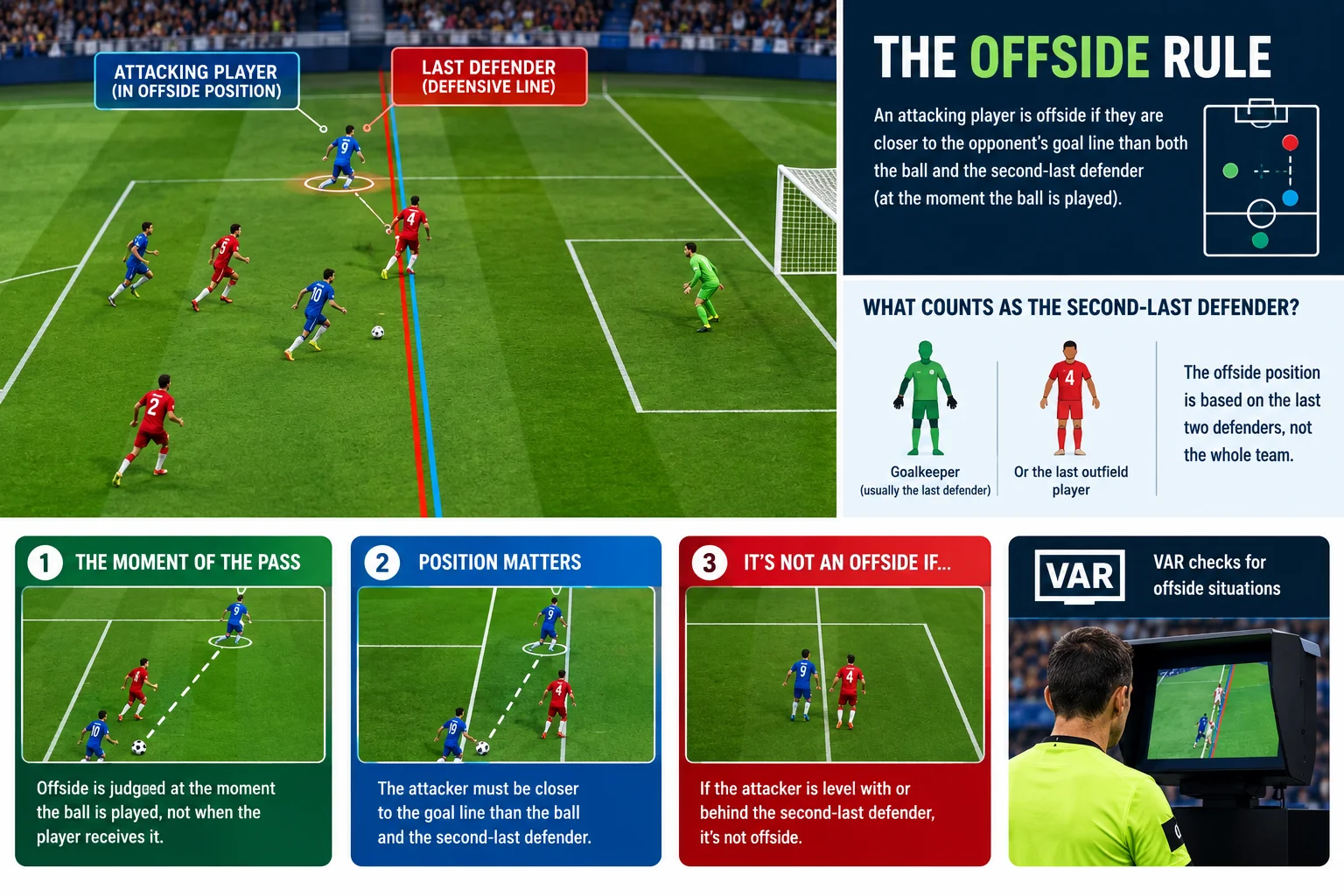
Offside is the rule everyone has heard of and few can state correctly. It has been part of football almost from the beginning, it shapes how every attack and defence is organised, and it produces more argument than any other law in the game. Most of the confusion comes from people half-remembering a version of the rule that has since changed.
Here is what it actually says, why it exists, and why it causes so much trouble.
What does the rule actually say?
A player is offside if they are nearer the opponent’s goal line than both the ball and the second-last opponent when the ball is played to them, and they are then involved in active play.
The second-last opponent is usually the last outfield defender, since the goalkeeper is normally the last. Being in an offside position is not an offence in itself; it becomes one only when the player becomes involved, by playing the ball, interfering with an opponent, or gaining an advantage from the position. A player level with the second-last defender is onside, not offside.
That is the whole rule, and the detail that catches people out is the distinction between being in an offside position and committing an offence.
Why does offside exist?
To stop players from simply waiting by the goal.
Without an offside rule, an attacker could stand next to the opponent’s goalkeeper and wait for a long pass, turning football into a game of hopeful punts towards a player camped in the penalty area. The offside rule forces attackers to time their runs, staying level with or behind the defence until the ball is played, which is what creates the constant movement and the defensive line that define how football is played.
The rule exists, in other words, to make the game a game. Everything about how teams attack and defend follows from it.
How has it changed?
Repeatedly, and usually to favour attackers.
The rule has been adjusted many times over football’s history, generally to encourage more attacking play. The number of defenders a player had to be behind was reduced. The “active play” clarifications were added to stop players in offside positions being penalised when they had no effect on the move. The interpretation of “level with” was settled in the attacker’s favour. Each change was meant to produce more goals and more open football.
The most recent arguments concern the margins, since video review can now measure offside to a precision the naked eye cannot, which has created a new kind of controversy the rule was never designed for.
Why does it cause so much argument?
Because it is a judgement made in an instant about a fast-moving situation.
An assistant referee has to judge, at the moment the ball is played, whether an attacker was ahead of the second-last defender, while both are often moving in opposite directions at speed. The human eye cannot do this perfectly, and close offside calls have always been a source of dispute. The rule itself is not especially complicated; applying it in real time is extremely hard.
Video review was meant to settle this and in some ways has, by measuring the positions precisely. But measuring offside to the width of a boot has produced goals ruled out by margins invisible to everyone watching, which many feel defeats the purpose of a rule meant to penalise a clear advantage. Our piece on why set pieces win Premier League matches covers another area where the margins decide matches.
What is the difference between offside and a foul?
They are entirely separate, and confusing them is common.
A foul is an unfair physical act against an opponent: a trip, a push, a dangerous challenge. Offside is a positional offence with no physical contact involved; it is about where a player is standing when the ball is played, not what they do to anyone. An attacker can be offside without going near a defender, and a foul can happen anywhere on the pitch regardless of position.
The two are judged by different officials in different ways. A foul is a matter of judgement about contact and intent; offside is a matter of position at a precise instant. Keeping them separate is the first step to understanding either.
How do defences use it?
By holding a line, which is one of football’s most practised skills.
A defence that pushes up together, keeping all its defenders level, can catch attackers offside by stepping forward in unison just as the ball is played, leaving the attacker ahead of the line and offside. The offside trap, as it is known, is high-risk and high-reward: executed well, it kills an attack before it starts; executed badly, by one defender stepping up late, it leaves an attacker clean through on goal.
The defensive line is the organising principle of modern defending, and it exists entirely because of the offside rule.
Can you be offside from a throw-in?
No, and it is one of the rule’s useful exceptions.
A player cannot be offside directly from a throw-in, a goal kick or a corner. These exceptions exist to keep the game flowing in situations where an offside rule would be impractical or unfair, and they are worth knowing because they occasionally produce a goal that looks offside but is not. An attacker standing behind the defence when a throw-in is taken to them is onside, however far forward they are.
Knowing the exceptions is part of understanding the rule properly, and it explains the occasional goal that leaves a defence appealing in vain.
Why it matters
Offside is the rule that shapes the geometry of football. The defensive line, the timing of attacking runs, the constant movement along the edge of the last defender: all of it follows from this one law. Understanding it properly is the difference between watching football and understanding what you are watching.
Frequently asked questions
What is the offside rule in simple terms?
A player is offside if they are nearer the opponent’s goal than both the ball and the second-last defender when the ball is played to them, and they then become involved in the play.
Is being in an offside position a foul?
No. It becomes an offence only when the player becomes involved in active play, by playing the ball, interfering with an opponent, or gaining an advantage from the position.
Why does offside cause so much argument?
Because it is a split-second judgement about fast-moving players, which the human eye cannot make perfectly, and because video review now measures it to margins invisible to the naked eye.



 Jesse Hall