Daniel Whitmore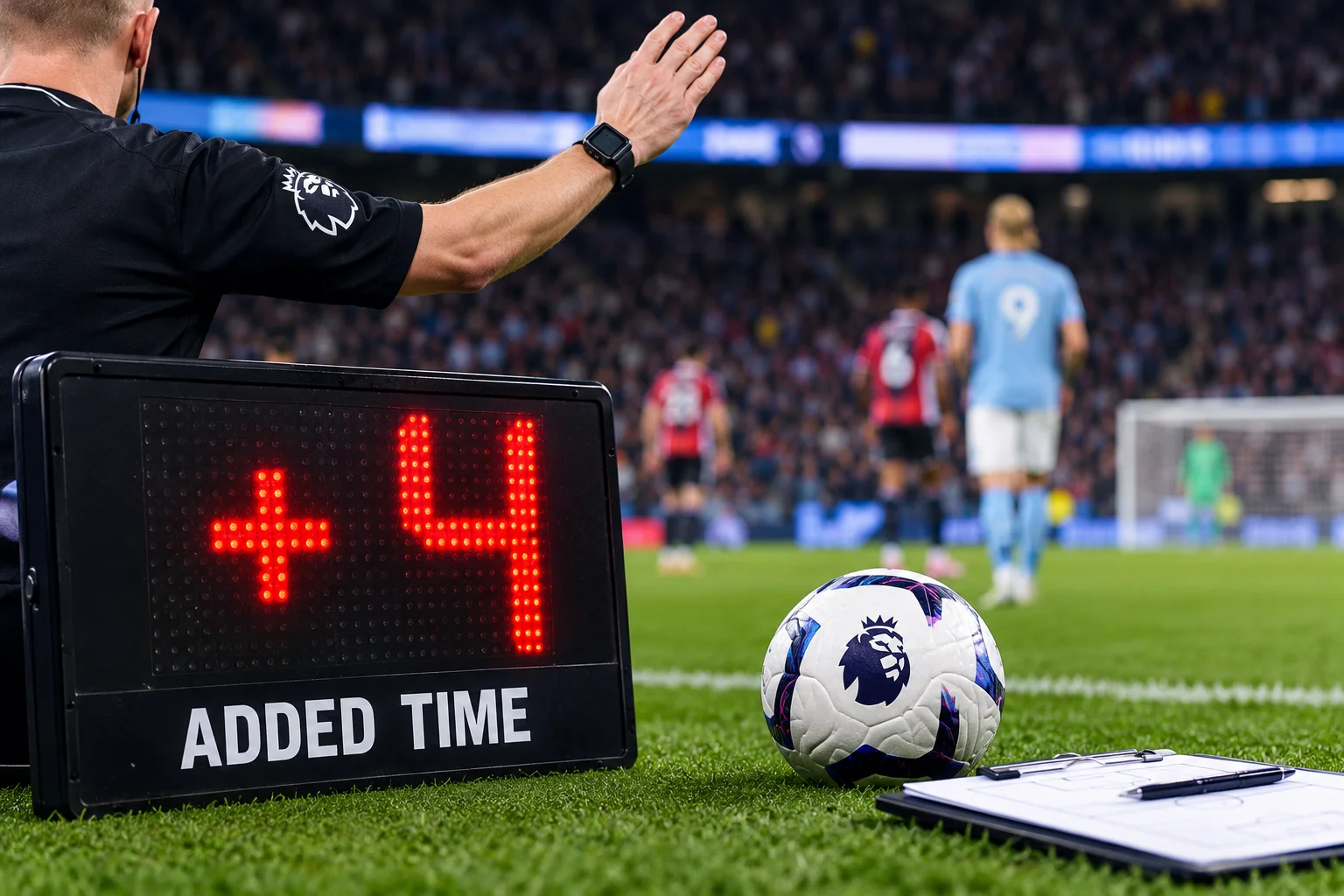
Few things in football produce as much confusion as the number held up by the fourth official. Supporters treat it as arbitrary, commentators describe it as generous or stingy, and almost everyone assumes the referee picks a figure that feels about right.
The laws are more specific than that, and the recent increase in stoppage time was a change in how strictly they are applied rather than a change in the rules themselves. Once you know what a referee is required to account for, the numbers stop looking random.
What the laws actually say
The relevant law deals with the duration of the match and requires the referee to make an allowance in each half for all time lost through a defined list of causes: substitutions, assessment and removal of injured players, deliberate time-wasting, disciplinary sanctions, stoppages for drinks or cooling breaks, delays relating to video review, and goal celebrations.
The important word is “allowance”. The referee is not estimating how long the ball was out of play; he is adding back time lost to those specific categories. The clock does not stop for a throw-in or a corner taken slowly, because those are part of the game rather than a stoppage, which is why a scrappy half with many fouls can produce less added time than a clean half with four substitutions and three goals. The IFAB, which writes and maintains the laws, publishes them in full each season.
Why the amount increased
For many years the categories were applied loosely. A goal celebration might take ninety seconds and be counted as thirty. A substitution might take forty seconds and not be counted at all. The result was a match in which the ball was in play for less than an hour and the added time came to three minutes.
The push to apply the law as written came from the governing bodies rather than from referees, and it arrived in major tournaments before it reached domestic leagues. Counting celebrations and substitutions properly immediately produced much longer stoppage periods — eight, nine, sometimes more than ten minutes — which was startling to watch and entirely consistent with the existing law.
Domestic competitions followed, and after an initial spike the figures settled somewhat, partly because players adjusted. If celebrations and substitutions are being counted, there is less incentive to stretch them out.
Why is the displayed number a minimum?
Because the law gives the referee power to extend the allowance further for anything that happens during it. If a goal is scored in the fourth minute of added time, the celebration must itself be added. If a substitution is made, the same applies. An injury during stoppage time extends it again.
This is why a board showing five minutes regularly produces seven, and why a team losing by a goal keeps playing long after the announced period has passed. The fourth official’s number is the minimum the referee has already accounted for, not a deadline.
The other half of the explanation is that a half cannot end while the ball is in a promising position in certain circumstances — a referee will generally allow a passage of play, or a set piece already awarded, to be completed. That is custom rather than law, but it is consistently applied.
The fourth official’s board, and who decides the number
The figure comes from the referee, not from the fourth official, who simply displays what he is told. In the professional game the time lost is tracked through the match rather than estimated at the end — the fourth official and the assistants keep a running note of substitutions, injury stoppages and significant delays, and the referee is given a total as the half approaches its close.
That is why the number sometimes appears to arrive late, and why it can differ from what a viewer at home has calculated from the broadcast clock. Television timing and the referee’s watch are not the same thing, and the broadcaster’s own stoppage estimates have no official status at all.
In competitions with video review there is a further layer. Review delays are logged separately and added in full, which is one of the larger contributors to the longer stoppage periods seen since video review was introduced.
What a referee cannot do
He cannot reduce the allowance to punish a team, and he cannot refuse to add time he has accounted for. He also cannot end a half early, except in the circumstances the laws provide for abandoning a match.
What he can do is use the allowance against a side that has been wasting time, which is the point of counting deliberate delay as a category. A goalkeeper taking a minute over a goal kick is adding to the time his own side will have to survive, and referees are now explicit with captains about that.
What it has done to the end of a match
The practical effect is that the last ten minutes of a football match are now a distinct phase with their own rhythm. Both sides know a substantial period is coming, which changes how a leading team manages the ball and how a chasing team commits players forward.
It has also made certain forms of time-wasting pointless. A substitution made purely to run the clock down now adds to the clock, and a goalkeeper taking an age over a restart is handing time back. Players have adapted faster than the commentary around them, and the sort of cynical late-game management that used to be routine is now visibly rarer.
The side effect is physical. Matches that regularly run to a hundred minutes of playing time represent a meaningful increase in load across a season, and clubs have factored it into how they rotate.
Does longer added time change results?
A little, and in a predictable direction. More time means more chances for the side that is behind, and the proportion of goals scored in stoppage time has risen as the periods have lengthened. That favours attacking teams and teams with strong benches, because fresh attackers against tired defenders is the most productive late-game pattern there is.
It has also changed how managers use substitutions. Making a change in the eighty-eighth minute used to be close to pointless; with the knowledge that eight minutes may follow, it is a real tactical decision. Set pieces matter more in that period too, which is why clubs drill them so hard, as we explain in why set pieces win Premier League matches.
Frequently asked questions
Does the clock stop in football?
No. The referee keeps time continuously and adds an allowance at the end of each half for time lost to specific causes, rather than stopping the clock during stoppages.
What counts towards added time?
Substitutions, injury assessment and removal, deliberate time-wasting, disciplinary sanctions, drinks and cooling breaks, video review delays, and goal celebrations.
Can added time be longer than the board says?
Yes. The displayed figure is a minimum, and anything that happens during the added period — a goal, a substitution, an injury — extends it further.
Why does a slow throw-in not add time?
Because routine restarts are treated as part of play rather than as stoppages. Only deliberate, obvious time-wasting falls into the category the referee must account for. Crowd figures are similarly misunderstood, as how football attendances are counted explains.