Daniel Whitmore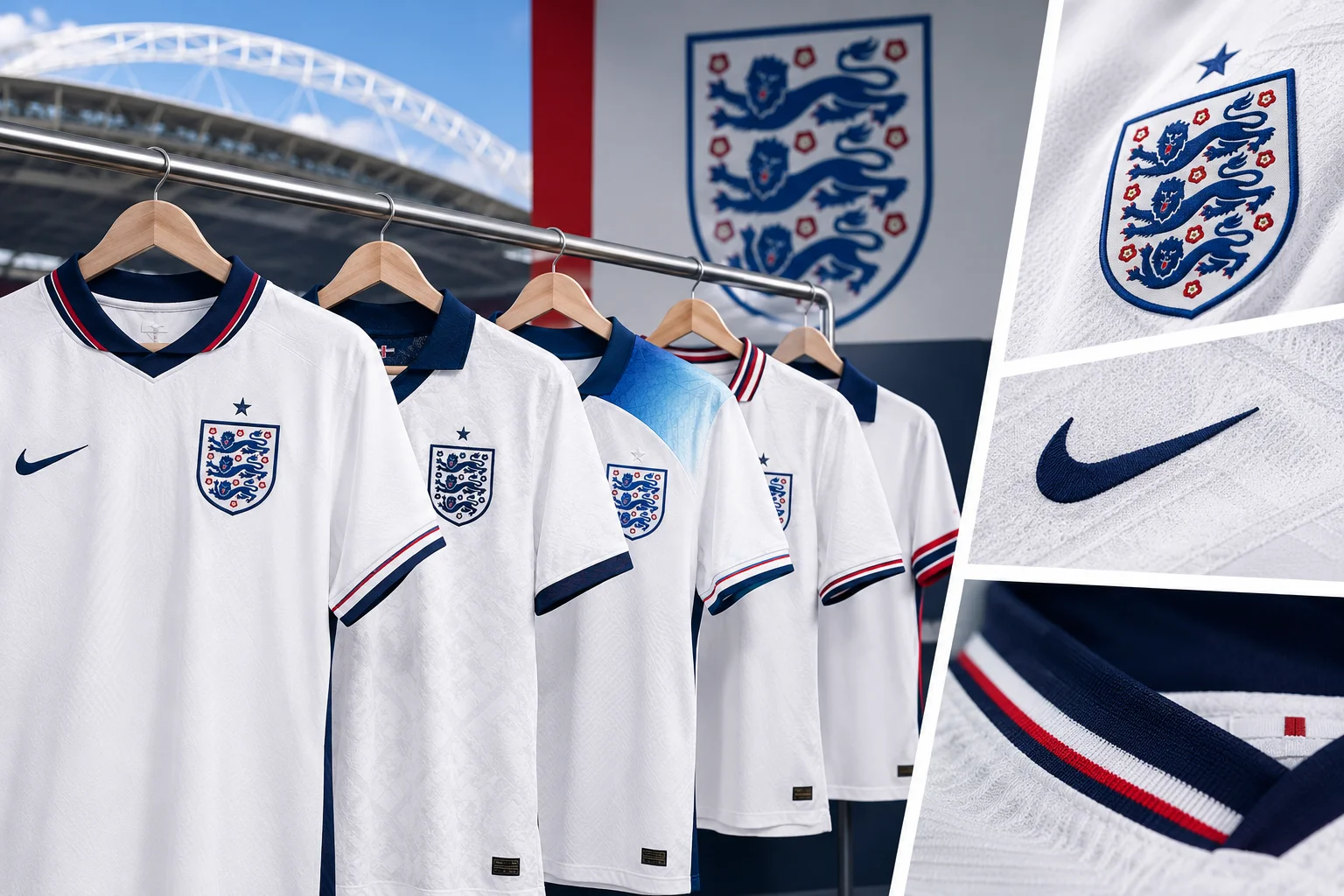
At a glance, every England home shirt looks the same. White, a crest on the left, some red or navy somewhere. Line ten of them up from different cycles and the differences appear, but they are small and easy to miss, which makes the home shirt both the safest England purchase and the hardest to tell apart.
Knowing where to look changes that.
Why is the home shirt always white?
Because it has been white since the first international in 1872, and nobody has seriously proposed changing it.
England’s original colours were white shirts and navy shorts, chosen at a time when the national team’s identity was being invented from nothing, and they stuck. White is now so closely tied to England that a home shirt in any other colour would read as a mistake. That leaves designers with an unusually narrow brief: keep the white, and change something else.
What actually moves between cycles?
Four things, in roughly this order of visibility.
The collar changes most. Round necks, V-necks, polo collars with buttons, and contrasting trim have all appeared, and the collar is usually the quickest way to separate two white shirts. The trim comes next: the placement of red and navy at the cuffs, the shoulders or the sides, and sometimes a subtle pattern worked into the fabric itself.
Then the crest, since the Three Lions badge has been redrawn several times, and finally the manufacturer’s logo, which changes on its own multi-year cycle and cross-references usefully against the rest.
How do you tell one cycle from another?
Start with the manufacturer’s logo, since without a sponsor it does the work a club shirt’s sponsor would do.
England’s kit supplier has changed only a handful of times, so the logo narrows a shirt to a block of years immediately. Within that block, the crest version narrows it further, and the collar and trim usually settle it. Photographs from the relevant tournament are the final check, because the home shirt is worn at every finals and there is no shortage of images.
Shirts from cycles when England did not reach a tournament are the hardest, simply because they were photographed less.
Which home shirts are worth having?
The ones tied to a tournament people remember, and one or two that stood out on design alone.
For England, results matter more than looks in the retro market. A home shirt from a tournament where the team went deep holds interest for decades. A home shirt from a cycle that ended in early exit or failure to qualify is forgotten regardless of how it looked. That is the reverse of most club shirts, where design usually wins.
The exceptions are the cycles that did something unusual with the trim or pattern. Those stay recognisable because they broke the white-and-plain convention, and recognisability is most of what keeps a shirt wanted.
What should you check before buying?
Everything that white reveals, which is a lot.
Opacity first: on a mannequin the fabric should not show the form underneath, and if it does the knit is too light. Panel consistency second: the white at the sleeves should exactly match the body, and a tonal difference means mixed fabric. Crest attachment third: a heat pressed badge shows a faint rectangular outline on white that an embroidered one does not.
Anyone comparing england home shirt listings should also look hard at the red trim. Red is among the least stable dyes and bleeds into white readily if it has not been fixed properly, so the boundary between red and white should be a clean line.
Do the shorts and socks help identify it?
They do, and they are often overlooked.
England’s home kit has used navy shorts for most of its history, but white shorts have appeared in certain cycles, usually where the opponent’s colours required it or where the design called for an all-white look. The socks have moved between white, navy and combinations with red trim. A full kit therefore carries more dating information than the shirt alone, and a shirt sold with its original shorts is easier to place than one on its own.
For a buyer, the shorts and socks also matter for a different reason: they are sized separately from the shirt, and a kit sold in a single size assumes chest and waist fall in the same place on the chart. Buying pieces separately usually fits better.
Does the kids’ version match the adult shirt?
Broadly, with simplifications.
Children’s England home shirts follow the adult design and the same tournament cycle, sized by height range rather than age. Where the adult shirt carries a subtle pattern in the fabric, the children’s version sometimes drops it, so a kids’ shirt may not match the adult one in every detail even from the same cycle. The height figure on the listing is far more useful than the age band.
Replica or player version?
The replica, for almost everyone.
Player versions are lighter, tighter and built for playing rather than watching. They use separate size charts and are cut noticeably closer through the chest and shoulders, so ordering one in your usual replica size gives you something too tight. For a shirt worn to matches or casually, the replica is more comfortable, more durable and usually cheaper.
Measure a shirt you already own across the chest, armpit seam to armpit seam, and match that figure to the chart. On a white shirt, if you are between sizes, the larger is the safer choice.
One further check for anything sold as vintage: the label. Neck and wash labels changed construction across the decades, and a label style that does not match the claimed era is a sign the shirt is a reproduction. That is not a problem if you are buying to wear, but it should be reflected in the price.
When should you buy?
After a tournament, not before one.
International shirts run for roughly two years and demand peaks in the months before a finals. Once the tournament ends, demand drops and sellers reduce stock they know will be replaced. The autumn after a summer tournament is reliably the cheapest moment for the current home shirt, and it stays current for another year or more.
For how the league’s shirts compare, our Premier League shirts season guide covers what changes on club kits each year.
In the end, the home shirt is the England purchase that never goes out of place. It is worn at every tournament, it matches every image of the team anyone carries in their head, and a well-made one from any cycle looks right decades later. The away shirt is the more interesting buy, but the home shirt is the one people keep.
Frequently asked questions
Why is the England home shirt white?
Because England’s original colours from 1872 were white shirts and navy shorts, and the white has never been changed.
How can I tell which year an England home shirt is from?
Start with the manufacturer’s logo, then the crest version, then the collar and trim. Tournament photographs confirm it.
When is the best time to buy an England home shirt?
The autumn after a summer tournament, when demand has dropped and the shirt still has a year or more of the cycle to run.