Daniel Whitmore
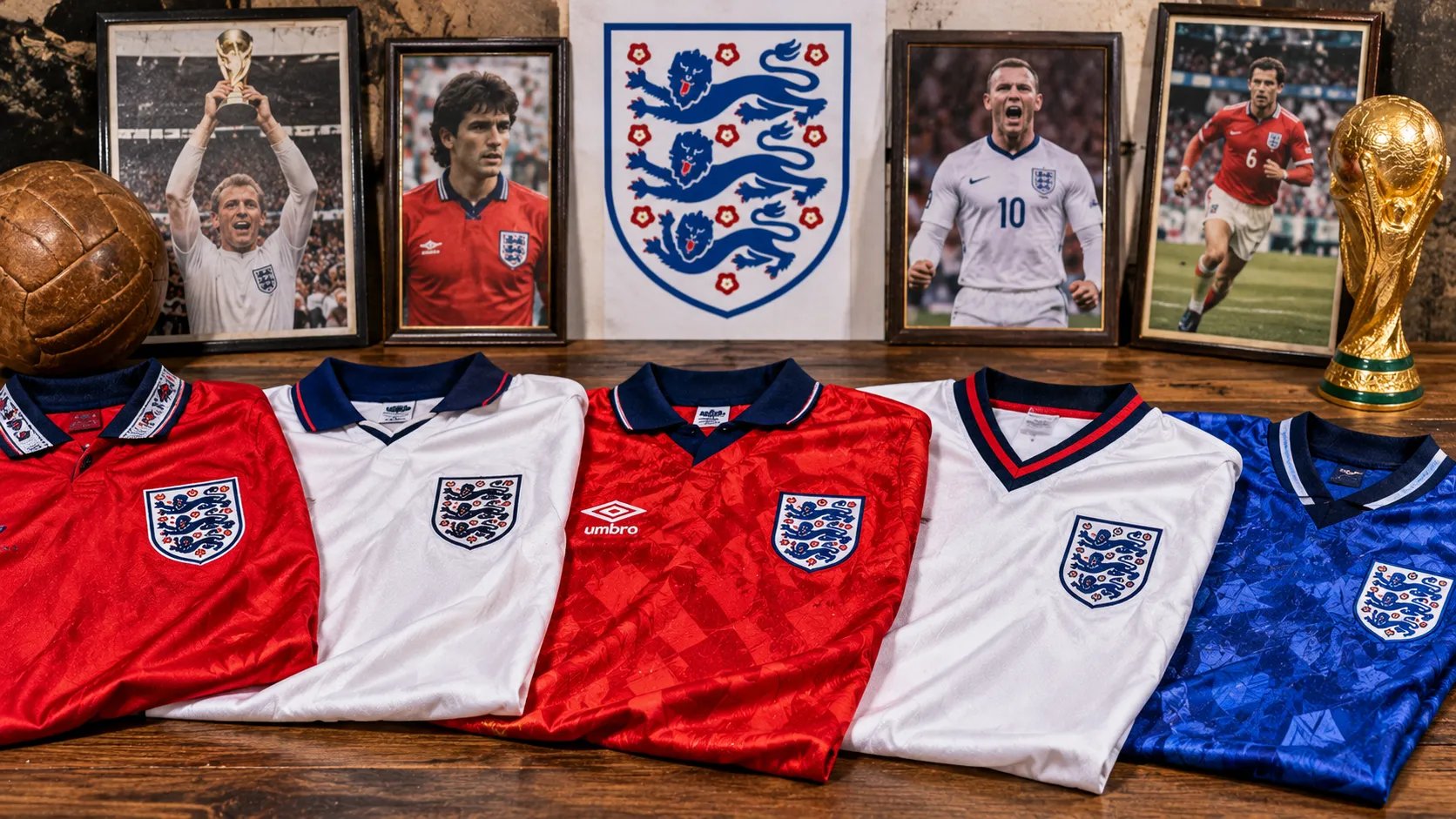
The simplest way to understand england retro shirts is to go tournament by tournament, because the shirts are remembered through the matches rather than the designs. Nobody buys a 1990 shirt because of the pattern on the collar.
That also makes them easy to date. Each major tournament has a kit attached to it, the suppliers changed on a known schedule, and the whole history fits into a handful of eras.
1966 and the red shirt
The most famous England shirt is not white. England wore red in the World Cup final against West Germany at Wembley in July 1966, because the Germans had the white, and the side that won the tournament did it in the change kit.
That has a consequence for collectors: the shirt most people picture when they think of 1966 is the one England wore once in the match that mattered, not the one they wore through the tournament. Both exist as reproductions and the red one is considerably more popular.
Long sleeves, a simple crest, no sponsor and no supplier branding on the front. The FA holds the records from that tournament, and the kit itself is about as plain as international football has ever been, which is a large part of why it reproduces so well.
The Admiral years
Between 1974 and the early eighties, England’s kit was made by Admiral, and this is where international shirts became commercial products. Admiral were the first to license a national team kit for retail sale, which changed the economics of the whole industry.
The designs are instantly recognisable: red, white and blue striped trim across the shoulders and down the sleeve, applied with a confidence that looks dated now and looked modern then.
The period is also the one England supporters remember least fondly, because the team failed to qualify for the 1974 and 1978 World Cups. The shirts are better than the results, which is not an unusual combination.
1982 to 1990
Umbro took over from the mid-eighties and the kits became cleaner. The 1986 shirt from the Mexico World Cup is a strong design and is attached to a tournament England supporters remember for a quarter-final that is still argued about.
Italia 90 is the big one. England reached the semi-final and went out on penalties, and the kit from that tournament home and the pale change shirt is among the most reproduced England kits of all. The goalkeeper shirts from the period are extraordinary objects in their own right.
What makes the 1990 shirt valuable as an object is that it coincides with the moment English football’s relationship with its national team changed. Collectors buy the tournament, not the garment.
Which era should you actually collect?
Depends on what you want from it. For a single iconic shirt, 1966 in red, and accept that everyone will recognise it.
For design, the Admiral period, because those kits look like nothing else and a reproduction costs very little. For a tournament with real emotional weight, 1990. And for something less obvious, the Euro 96 grey away shirt, which is one of the stranger decisions in kit history and has developed a serious following.
The practical consideration is availability. Anything from 1990 onwards was produced in large enough numbers that genuine period shirts still turn up; anything before 1980 is scarce in wearable condition and most of what you see is reproduction.
Euro 96 and the grey shirt
Worth its own section because it is the strangest decision in England kit history and has aged into one of the best-loved shirts the country has produced.
England played in a pale grey change kit at Euro 96, including the semi-final against Germany at Wembley, in a tournament held at home where a change kit was barely necessary. The reasoning was commercial and the result was a shirt that looked like nothing an international side had worn before.
At the time it was widely disliked. Thirty years later it has a following that rivals the home shirt from the same tournament, which is the usual trajectory for a kit attached to a tournament people remember fondly. Shirts get reassessed when the matches they were worn in become history.
The home shirt from that summer is the better design and the grey one is the better story. If you are buying one England shirt from the nineties and 1990 feels too obvious, that is the one.
What should you check before buying?
Supplier and crest together, which will place a shirt within a few years. The Three Lions crest has been through several treatments and the detail level is a quick quality test on a reproduction.
Sleeve length matters more for England shirts than for club ones, because long sleeves were standard in several eras and a short-sleeved version of a kit that was worn long is either a legitimate alternate or a reproduction that did not do its homework.
Fabric weight last. Period shirts from the sixties and seventies were heavy cotton, from the eighties onwards increasingly synthetic, and a shirt that feels wrong in the hand usually is. Our England home shirt guide covers the current range on the same principles.
Reproductions, reissues and what you are buying
Three different things are sold as retro England shirts and the price gap between them is substantial.
Genuine period shirts are the garments actually sold at the time. For anything before the mid-eighties these are scarce, usually worn, and priced accordingly. Condition matters more than anything else and the crest is where to look first.
Official reissues are modern productions of historic designs, licensed and made to a decent standard with modern fabric and a modern cut. These are the sensible purchase for most people you get the design, it fits, and you can wear it.
Unlicensed reproductions are the third category and vary enormously. Some are careful work by people who care about the detail; most are approximations with the wrong crest proportions and the wrong fabric. The price usually tells you which you are looking at, and a reproduction of a 1966 shirt for the cost of a takeaway is not a careful piece of work.
Why international shirts hold value differently
Because the supply is odd. Clubs release a new kit every season and sell it to a fixed support; international teams release kits on a two-year cycle and sell them to a general public that buys mainly around tournaments.
The effect is that England shirts from tournament years are abundant and shirts from non-tournament years are genuinely scarce. A qualifying-campaign shirt that never appeared at a major finals can be harder to find than a famous one, and costs less because nobody is looking for it.
That is where the value is for anyone collecting seriously rather than buying a souvenir. The famous shirts are priced on demand; the forgotten ones are priced on nothing at all. The commercial machinery that sets those release cycles is covered in how a football club actually makes money.
Frequently asked questions
Why did England wear red in 1966?
Because West Germany had the white kit for the final, so England played in their change strip. The red shirt is the most famous England kit despite being worn in only that match of the tournament.
What was the Admiral era?
From 1974 to the early eighties, when Admiral made the kit and became the first company to license a national team shirt for retail. The designs feature red, white and blue shoulder trim.
Which England shirt is most collectable?
1966 in red for iconic status, Italia 90 for emotional weight, and the Euro 96 grey away shirt for something less obvious with a strong following.
Are non-tournament England shirts worth buying?
They are the best value in the market. Qualifying-campaign shirts were made in smaller numbers, are harder to find, and cost less because demand concentrates on tournament years.