Daniel Whitmore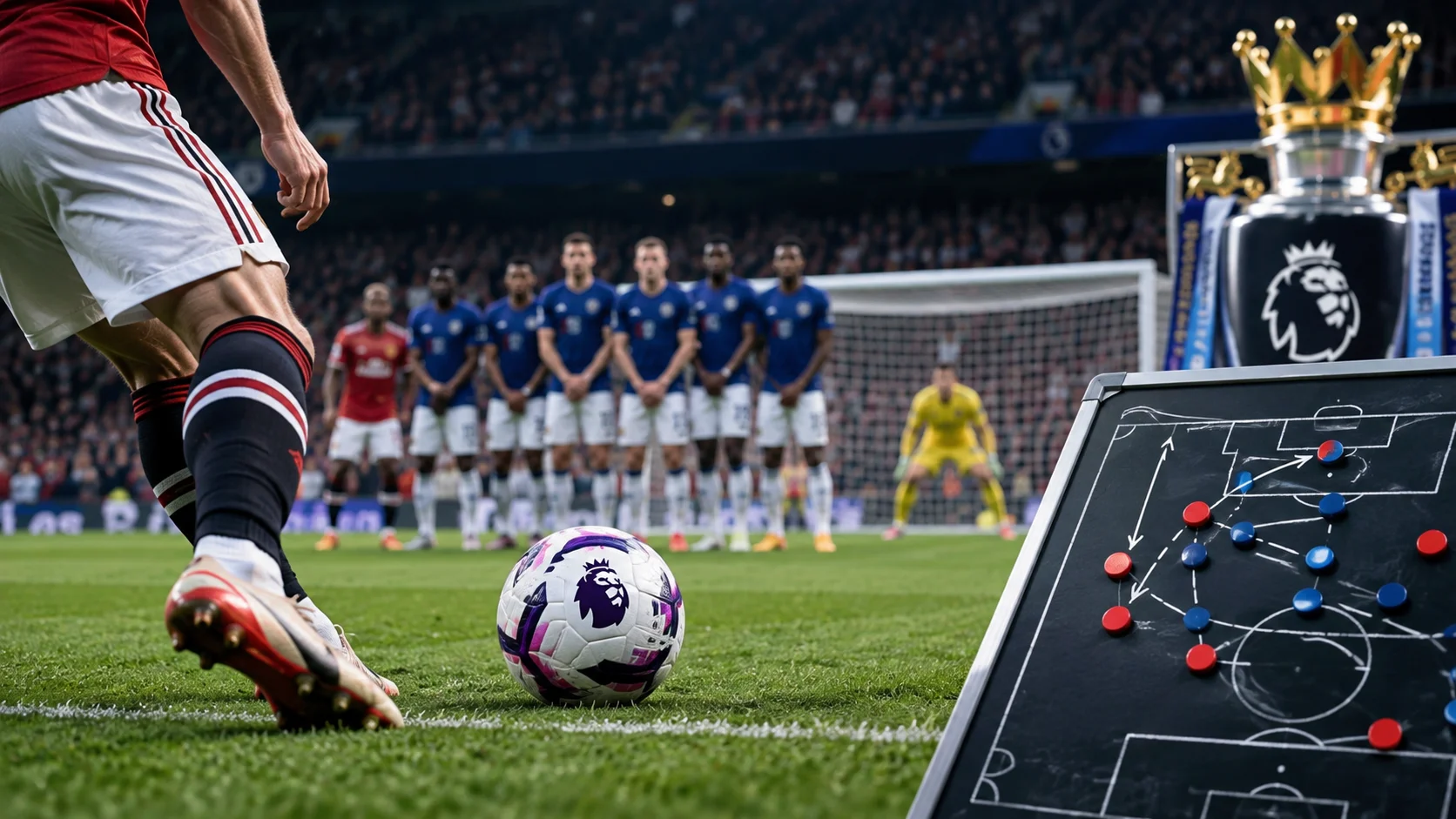
When supporters remember great goals, they think of flowing moves, long-range shots and moments of individual skill. Far fewer remember the corner that was headed in at the near post or the free kick that was flicked on and bundled over the line. Yet those goals count exactly the same, and in the Premier League they decide a remarkable number of matches.
Set pieces have gone from being treated as a bonus to being one of the most carefully planned parts of modern football. The reasons behind that shift explain a lot about how the game has changed.
What counts as a set piece?
Any situation where play restarts from a stationary ball.
That includes corners, free kicks, penalties and throw-ins. In every one of them, the attacking team knows where the ball will be and can plan exactly what it wants to do. The defending team has to react. That advantage, the ability to rehearse in advance, is what makes set pieces so valuable.
In open play, everything is chaotic and unpredictable. At a set piece, a well-drilled team can run a move it has practised many times, with every player knowing their role.
Why have set pieces become so important?
Because open play has become harder to score from.
Modern defences are extremely well organised. Teams press in a coordinated way, defend in compact shapes and leave little space between the lines. Breaking down a well-organised side through open play can take a long time and often does not happen at all.
A set piece bypasses much of that organisation. The defending team cannot use its pressing or its compact shape in the same way, and the match becomes a contest of height, timing and movement in a small area. For a side that struggles to create chances from open play, set pieces offer a reliable alternative route to goal.
How do teams plan their set pieces?
In considerable detail, and many clubs now employ specialist coaches just for this.
Teams study how opponents defend corners and free kicks, looking for weaknesses. Some sides mark individual players, others defend zones of the penalty area, and many use a mix. Each approach leaves different gaps, and a good set-piece coach designs routines to exploit them.
Routines might involve decoy runs to drag defenders out of position, blocks that free a particular player, or deliveries aimed at one specific area. The same move is practised repeatedly in training so that on matchday every player knows exactly where to go.
Why are set pieces so valuable for smaller clubs?
Because they level the playing field.
A club with less money than its opponents may not be able to match their technical quality in open play. But set pieces depend more on height, organisation and practice than on individual brilliance, and those things can be developed at any budget.
This is why many clubs fighting relegation or punching above their weight rely heavily on set pieces. A side that is strong from corners and free kicks can compete with far richer opponents, and several promoted sides have survived largely on the goals they scored from dead balls.
What makes a great set-piece taker?
Consistency above everything.
A good taker can put the ball into the same area time after time, with the right pace and height for the routine the team has practised. That reliability matters more than spectacular technique, because the whole routine depends on the ball arriving where the runners expect it.
Direct free kicks are a different skill. Scoring from them requires a rare combination of accuracy, power and the ability to bend the ball over a wall and away from the goalkeeper. Players who can do that consistently are few, and they are prized by their clubs.
How important are long throws?
More than they used to be, and some sides treat them almost like corners.
A long throw into the penalty area puts the ball into a crowded space in much the same way a corner does, but without the ball having to leave the pitch first. Teams with a player who can throw the ball a long way use it as an extra attacking weapon, particularly against sides that struggle with high balls.
Opponents often find long throws awkward to defend, because they arrive at a flatter angle than corners and can be taken quickly before the defence is fully set.
What role does the goalkeeper play?
A central one, especially when defending.
A goalkeeper who commands the penalty area, coming off the line confidently to catch or punch crosses, can take a great deal of danger out of set pieces. A goalkeeper who stays rooted to the line invites teams to put balls into the six-yard box. Attacking sides study this closely and often aim deliveries to crowd or block the goalkeeper’s path.
Can defending set pieces be improved?
Yes, and it works in both directions.
Just as teams plan how to attack set pieces, they plan how to stop them. That means choosing a defensive system, making sure the tallest players are in the right positions, and concentrating fully at the moment the ball is delivered. Many set-piece goals come from a single lapse in concentration.
A team that concedes regularly from set pieces can improve quickly with better organisation, which is why coaches spend time on defending corners as well as attacking them.
Is there such a thing as a set-piece specialist team?
Some sides build an identity around them. They recruit tall, strong players, practise routines relentlessly and treat every corner as a genuine chance to score. Opponents come to dread conceding free kicks anywhere near their penalty area against such teams, which in turn makes defenders more cautious about committing fouls. That caution is a small advantage in itself.
Do set pieces make the game less entertaining?
Some supporters feel they do, preferring goals from flowing football. But set pieces bring their own drama. A late corner with the whole team up, a free kick on the edge of the area, a penalty in a tight match: these are some of the tensest moments in football.
And for the team that scores, a goal from a well-worked routine is the reward for hours spent on the training ground. It is as much a product of skill and planning as any other kind of goal.
For the shirts worn in all of these moments, our Premier League shirts season guide covers what changes across the league each year. And for another way teams shape their seasons, our piece on how the January transfer window shapes a season explains what clubs do midway through.
Frequently asked questions
What is a set piece in football?
A set piece is any restart from a stationary ball, including corners, free kicks, penalties and throw-ins. The attacking team can plan and rehearse exactly what it wants to do.
Why are set pieces so important?
Modern defences are hard to break down in open play. Set pieces bypass much of that organisation and give teams a reliable, rehearsed route to goal.
Why do smaller clubs rely on set pieces?
Set pieces depend more on height, organisation and practice than on expensive individual talent, so they allow smaller clubs to compete with richer opponents.


 Jesse Hall